Michelin-starred restaurants in Courchevel: The complete dining guide
Resumen
Michelin-starred restaurants in Courchevel: The complete dining guide
Courchevel has developed one of the most accomplished gastronomic scenes in the French Alps. Across the resort, Michelin-starred restaurants bring together internationally recognised chefs, long-established local figures and distinctive culinary concepts, creating a dining landscape that extends far beyond traditional mountain cuisine.
The 2026 Michelin selection recognised eight restaurants in Courchevel with a total of 13 stars. Since the guide was announced, several addresses have evolved, making it important to distinguish the official 2026 selection from the restaurants shaping the 2026–2027 winter season. From Yannick Alléno’s three-star cuisine to contemporary interpretations of Alpine produce and the culinary heritage of Savoy, the resort offers several very different approaches to fine dining.
Hacer una petición
Explore our selection of luxury villas in Courchevel and find the ideal setting for your next stay.
I. The Michelin-starred restaurants defining Courchevel 1850
Courchevel 1850 concentrates several of the resort’s most celebrated restaurants, but their proximity does not translate into a uniform dining scene. Each has developed a distinct culinary identity, shaped by the chef, the setting and a particular interpretation of French or Alpine gastronomy.
A. Le 1947 à Cheval Blanc
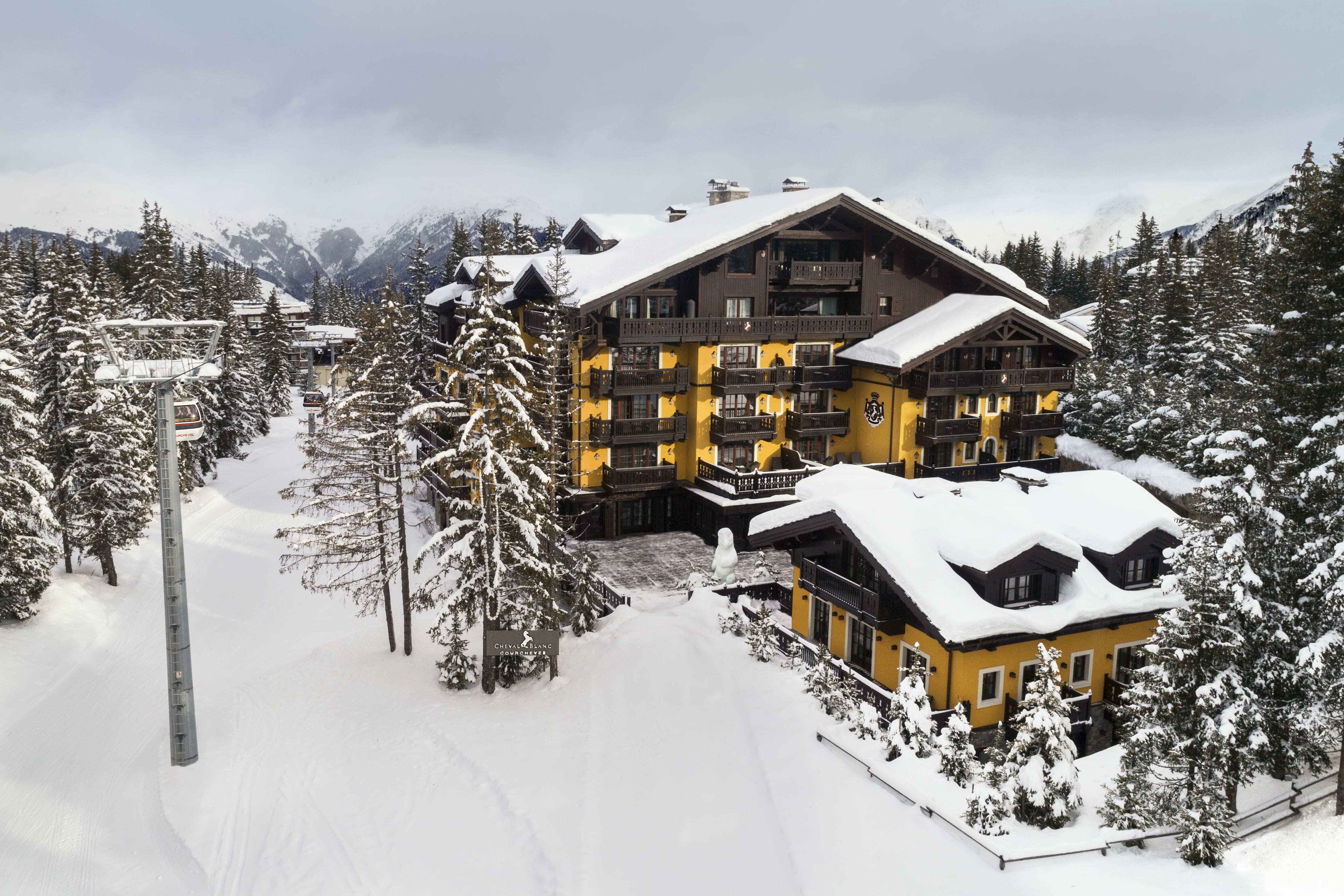
Le 1947 à Cheval Blanc remains Courchevel’s only three-Michelin-starred restaurant. Located within Cheval Blanc Courchevel in the Jardin Alpin, it is led by Yannick Alléno and represents the highest Michelin distinction currently found in the resort.
Alléno’s cuisine places considerable emphasis on technique, particularly his work around sauces, extraction and the concentration of flavour. The approach continues to evolve through research rather than relying on a fixed collection of signature dishes, allowing the menu to change from one season to another.
The dining room, designed by Sybille de Margerie, maintains a close visual connection with the kitchen. Its intimate scale reinforces the sense that dinner is conceived as a complete experience rather than simply a succession of courses.
B. Slalom 1850
At Le Strato, Slalom 1850 enters the 2026–2027 winter under a new identity, following the restaurant previously known as Baumanière 1850. Chef Thomas Prod’Homme remains at the helm of the two-Michelin-starred kitchen.
His cuisine brings together two environments that have shaped his culinary identity: the Mediterranean and the Alps. Seasonal mountain ingredients meet flavours and references connected to his southern roots, creating an approach that differs from a strictly regional interpretation of Savoyard cooking.
The restaurant structures its gastronomic experience around three menus, Slalom, Schuss and Sphère. Each offers a different way to explore Prod’Homme’s cuisine while maintaining the same dialogue between the mountains and the Mediterranean.
C. Le Chabichou
Le Chabichou represents a different chapter in Courchevel’s gastronomic history. Stéphane Buron joined the restaurant in 1987 and worked alongside Michel Rochedy for many years before taking sole responsibility for the kitchen in 2018.
Named Meilleur Ouvrier de France in 2004, Buron has developed a cuisine centred on carefully selected ingredients, seasonality and relationships with producers. Guests can discover his work through tasting menus of five, seven or nine courses.
Its longevity distinguishes Le Chabichou from more recent concepts in the resort. The restaurant has evolved alongside Courchevel itself, giving it a place within the destination’s culinary history as well as its current Michelin landscape.
D. L’Altitude
Located at Le K2 Altitude, L’Altitude received its first Michelin star in the 2026 selection.
Chefs Guillaume Duchemin and Davide Sessa use the foundations of traditional French cuisine as their starting point, revisiting classical techniques through contemporary execution. Sauces, seasoning and familiar references to French gastronomy remain central without being reproduced unchanged.
This direction gives L’Altitude a distinct position within Courchevel. While other restaurants draw heavily on Alpine terroir or personal culinary narratives, its identity looks more broadly towards the traditions that have shaped French haute cuisine.
II. Michelin gastronomy beyond central Courchevel
The Michelin experience is not confined to the centre of Courchevel 1850. Other tables explore the mountains through nature, regional history and highly personal culinary influences, while recent changes have also reshaped the resort’s Michelin landscape for winter 2026–2027.
A. Alpage
At Hôtel Annapurna, Alpage approaches the surrounding mountains through the cuisine of chef Jean-Rémi Caillon.
Rather than reproducing familiar Alpine recipes, the Michelin-starred restaurant uses the environment as a starting point for contemporary gastronomy. Seasonality and the character of mountain ingredients shape the menu, creating a connection to the destination without limiting the cuisine to traditional Savoyard references.
Alpage operates as an evening experience, giving the restaurant a rhythm separate from daytime life on the slopes. Its setting also offers another perspective on Courchevel beyond the concentration of restaurants in the centre of 1850.
B. Le Farçon
In Courchevel La Tania, Le Farçon has held a Michelin star since 2006 under chef Julien Machet.
His culinary identity is closely linked to the history of Savoy. Through the figure of the Colporteur Savoyard, Machet explores the routes and exchanges that historically connected Alpine communities with neighbouring territories, using this heritage as a framework for his menus.
Names such as La Route des Tommes and La Route du Sel reinforce this approach, turning dinner into an exploration of the wider Savoyard world. Its position on the snow front in La Tania also provides a reason to experience another village during a stay in Courchevel.
C. A changing Michelin landscape for winter 2026–2027
Two additional restaurants formed part of Courchevel’s 2026 Michelin selection but require a different approach when planning the coming winter.
Sylvestre Wahid – Les Grandes Alpes received two Michelin stars for a highly intimate concept shaped by the chef’s connections to Pakistan, the Mediterranean and the Alps. Following the events affecting Les Grandes Alpes in 2026, its operating situation for winter 2026–2027 should be confirmed before making plans.
Le Sarkara, at Le K2 Palace, also held two Michelin stars in the 2026 selection. Under Sébastien Vauxion, the restaurant developed an unusual gastronomic language around pastry techniques, vegetables and the relationship between savoury and sweet. Following the end of Vauxion’s collaboration with Le K2 Collections in August 2026, Le Sarkara will not return in its previous form for the coming winter season.
Both remain important when understanding Courchevel’s 13-star Michelin distinction for 2026, but their situations illustrate how quickly the resort’s gastronomic landscape can evolve between one winter and the next.
III. Planning a Michelin-starred dining experience in Courchevel
With several culinary identities concentrated within the same resort, planning restaurant reservations is less about choosing the greatest number of stars and more about creating variety throughout the stay.
A. Choosing between different culinary identities
Each Michelin-starred restaurant offers a different perspective on gastronomy. Le 1947 à Cheval Blanc represents Yannick Alléno’s highly technical approach, while Slalom 1850 brings Mediterranean influences into an Alpine setting. Le Farçon looks towards the history of Savoy, and L’Altitude revisits the foundations of classical French cuisine.
These differences are useful when planning several dinners during the same week. Selecting restaurants for their individual character rather than their Michelin ranking alone prevents one gastronomic experience from feeling too similar to the next.
The format of each restaurant can also influence the choice. A long tasting menu creates a very different evening from a shorter experience, particularly when dinner follows a full day elsewhere in the resort.
B. Considering location and timing
Courchevel functions as a single destination, but its Michelin-starred restaurants are distributed across several areas. Jardin Alpin, Pralong, central Courchevel 1850 and La Tania each require different journeys depending on the location of the chalet.
This becomes particularly relevant when travelling to Le Farçon in La Tania or dining in the higher areas of Courchevel 1850. Planning transportation at the same time as the restaurant reservation can make the transition between the day and evening considerably smoother.
Availability is another consideration during Christmas, New Year and the main winter holiday periods. Several restaurants operate with limited dining rooms or specific opening days, making advance reservations particularly important during the busiest weeks.
C. Creating a varied dining programme
Michelin-starred restaurants can form an important part of a week in Courchevel without defining every evening.
Alternating elaborate tasting menus with simpler dinners creates a more natural rhythm and leaves space to explore other aspects of the local dining scene. A gastronomic evening might be followed the next day by a more traditional regional table, while another night can be kept free for dinner at the chalet.
The objective is not to accumulate reservations, but to create a sequence of distinct experiences that fits naturally around the rest of the stay.
Experiencing Courchevel through its gastronomy
Courchevel’s Michelin-starred restaurants reveal a culinary landscape that is far more varied than the number of stars alone suggests. French haute cuisine, Alpine ingredients, Mediterranean influences and Savoyard history coexist within the same resort, giving each table its own perspective.
Choosing between these restaurants therefore becomes part of planning the wider stay. Location, menu format and culinary identity can all shape the rhythm of an evening and determine how naturally it fits into the week.